

My flight to New York City was cancelled, so I had a two day layover. Something positive came out of this inconvenience- I ate a delicious empanada de carne. Though empanadas originate in Spain, they are very popular in Peru and are generally baked (instead of fried).
The empanada I ate had ground beef, hardboiled egg, onions, olives, and raisins. Trust me, Peruvian empanadas are delicious though seemingly unconventional (like the pastel de choclo I wrote about in an earlier post). My empanada came nice and warm, and I sprinkled a little lime juice on it.
If this flavor combination does not appeal to you, empanadas come in many different varieties such as chicken, ham and cheese, and ones filled with only vegetables (for you vegetarians out there).
My layover let me enjoy some true Peruvian comfort food. I hope that if you come to Peru, you will sample one or many of the empanadas Peru has to offer but under different circumstances than I faced.
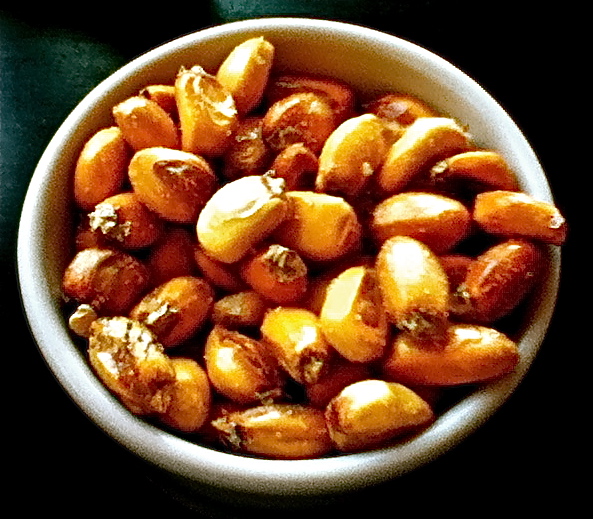
Cancha is economically savvy, but for whom? Not for the customer- it’s the restaurant that profits from this tasty corn snack. To make cancha, Peruvians toss dried corn kernels (from Peruvian corn called maiz which has a larger kernel than the corn found in the U.S.) in oil and toast them until puffed, crunchy, and golden brown. The corn is then sprinkled with salt.
In my opinion, many Peruvian restaurants serve these highly addictive munchies instead of bread to make people thirsty and want to order more drinks. If you eat enough of these you will start to feel full, but I find myself feeling more full after eating multiple pieces of bread. So restaurants are being very economical when serving cancha: they are cheap, not too filling (so people will still order a lot of food), and cause people to order more drinks.
At first, I felt pretty witty to have figured out restaurants’ master plan. I thought I would not fall into the temptation of eating these salty treats. But you know what, they taste really good, so ordering an additional beverage is worth it if I can eat some cancha.

Causa: a dish that when I look at the recipe, I scratch my head in confusion and wonder how it can work. Yellow mashed potato with avocado, hardboiled egg, and either chicken or canned tuna? What were Peruvians thinking? But seriously, causa is delicious, and I guess you could call it a Peruvian version of potato salad (a much better one at that).
The less traditional causa in the picture above is from La Mar (yes, I went there again) and has crabmeat and raw tuna. After trying causa, you will have no more reason to be confused of this seemingly unconventional dish.
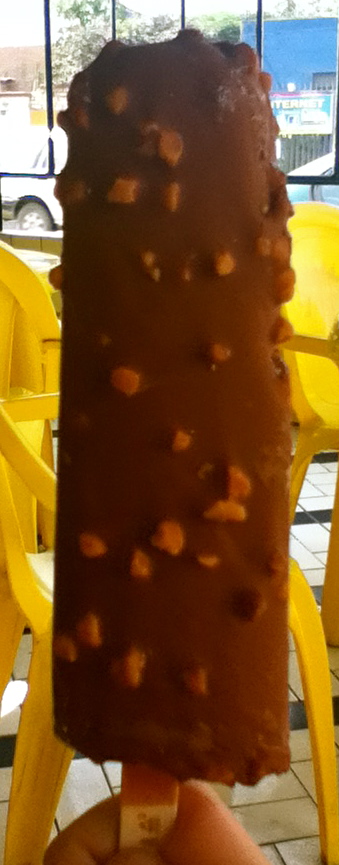
D'Onofrio Sublime Ice Cream Bar
I don’t want to mislead you with the title of this post, so I will get right to the point. The ice cream masseuse exists, and I have encountered her many times in Peru. She is the ice cream server at pretty much any ice cream joint in Peru I have been to, and I do have some feelings of animosity toward her.
Yesterday, since I figured I had already broken my New Year’s resolution, I ate a cone with two balls of ice cream- cappuccino and mango. Instead of using an ice cream scooper, the person used some sort of flat spatula. I saw the server put the spatula in the mango bin and get a nice-sized portion of ice cream.
Just when I thought she was going to put the ice cream in my cone, she put it on the side of the ice cream bin and started massaging it. Yes, she was massaging it and thus shrinking the size of the ice cream she was giving me.
Though thoroughly annoyed, the ice cream was delicious. The ice cream I bought was from a chain called Laritza, but another of my favorite ice cream chains is 4D. Both Laritza and 4D have wonderful ice cream with all the old favorites- chocolate, vanilla, strawberry, etc.- as well as flavors special to Peru such as granadilla and lúcuma.
After encountering the ice cream masseuse this year, I decided today to go for some D’Onfrio, which is another extremely popular ice cream brand in Peru owned by Nestlé since 1997. Most of the ice cream they serve is already packaged (like Good Humor) but is great quality and delicious. I ate the Sublime bar which is chocolate ice cream encased in a hard chocolate shell with nuts. This was very satisfying, but I know that soon again, I will purchase some fresh ice cream and find myself facing the ice cream masseuse.
I’ve tried many Peruvian-Italian fusion restaurants and have come across the same dishes I eat in the U.S.: pasta pomodoro, raviolis of all sorts, chicken milanese, etc. For some reason, these Peruvian attempts at Italian-inspired food seem like one large blur formed out of non-memorable dishes. Today, for the first time, I ate at one restaurant that stood above all the other Italian restaurants.
For lunch, my parents and I went to the restaurant Dánica,where I was delighted to eat some food that was truly remarkable. The three of us shared a salad of spinach with all the fresh veggies you could think of: carrots, tomato, corn, avocado, mushrooms, and peppers. Crispy noodles on top added texture to the salad, and the honey mustard vinaigrette added a sweet note.

For my entree, I ordered chicken breast with mushroom sauce, which came with “arroz con choclo” (rice with corn in it), and an amazing assortment of sauteed vegetables- fresh artichoke hearts (not the canned ones I get in the U.S.), red and green bell peppers, asparagus, and mushrooms.

Dánica converted me into a Peruvian-Italian fusion lover. Well maybe not exactly- nothing can top the chicken parmesan I order at Ottomanelli’s in New York City. Nevertheless, I would definitely go back to Dánica.
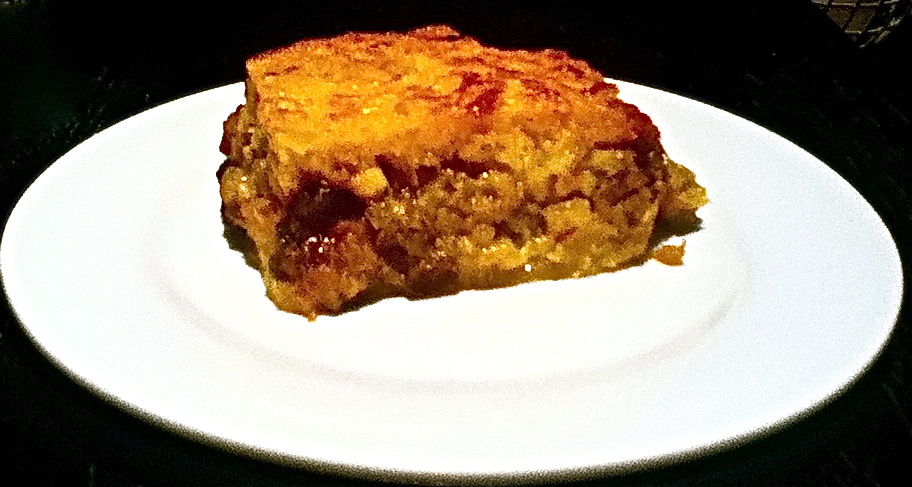
Though pastel de choclo is not the prettiest sight, I am telling you that this Peruvian dish made of fresh corn (choclo) and ground beef is delicious. I admit that at first I too was very hesitant to try this Peruvian meat pie because the combination of corn and beef sounded bizarre to me. (Though I am sure this dish is not bizarre enough to star in Andrew Zimmern’s Bizarre Foods). Much to my surprise, it only took me one bite to become completely enamored with pastel de choclo. The meat mixture was tart but sweet at the same time due to the raisins and onions that were incorporated within. Thus, the ground meat, which had the perfect balance of sweet and savory, did not overpower the delicious sweet corn.
My favorite places to get pastel de choclo are Tanta and Panchita. When I am back in the U.S. and craving some pastel de choclo, I will eat a large piece of cornbread knowing that I am missing out. If I am daring enough, I will attempt to recreate this delicacy.
-
- Placemat
-

- Entrance to Granja Azul
-

- Where we ate
-
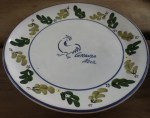
- Self-explanatory (this plate was not empty for long!)
-
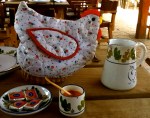
- Breadbasket
-
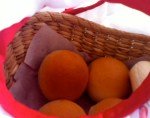
- Rolls
-
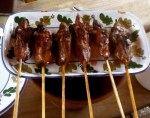
- Anticuchos
-
- Tomatoes
-
- Chicken with Salad and French fries
Yesterday, my parents and I paid a visit to Granja Azul, a restaurant about 30 minutes away from Lima which has been serving roasted chicken for over half a century. Since it was Monday, the restaurant was mostly empty, but on a Sunday, you will find this restaurant teeming with hungry people.
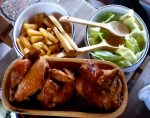
The menu is not extensive, so we all ordered a “Lunch Ejecutivo,” a meal including rolls that came in a cute basket shaped like a hen, anticuchos, half a roasted chicken, salad, and french fries. Anticuchos are a typical Peruvian dish and are just skewers with small pieces of grilled meat (generally beef heart). Granja Azul served us anticuchos of beef heart and chicken liver. I will be completely honest- I just tried them to write about them in this blog, and they certainly were not my favorite. Nevertheless, the locals love anticuchos, and I do not want to dissuade you from trying them. Animal organs are just not my thing.
The chicken was very flavorful but a little on the dry side. The salad was plain and came with tomatoes, and the fries were good.Overall, the lunch was substantial but nothing outstanding. The outdoor seating surrounded by beautiful scenery made up for my minor disappointment with the food. Still, if you have a short stay in Peru, I do not recommend making the effort to eat at Granja Azul. If you want juicy and succulent chicken, try Pardos Chicken. Though the ambience is not great, who cares if the food is delicious?
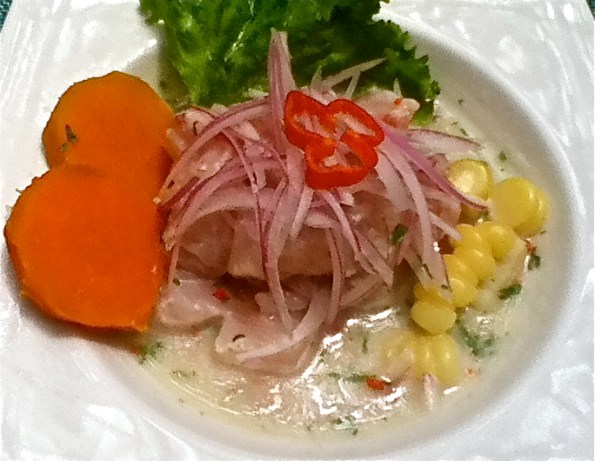
Ceviche from Segundo Muelle
I have been in Lima for a week now and have eaten ceviche three times already, so I figured I would write my next post on this delicious Peruvian dish. I must confess that one of these times was at a buffet, so I had a lot of other food on my plate besides ceviche (which is typical for me). I am the type of person restaurants had in mind when reducing the size of their buffet plates, so I would have to go back numerous times to get more food.
Instead of rambling about my eating habits, I shall get back to what was intended as the primary focus of this post- ceviche. Historians believe that the Moche, an ancient Peruvian civilization that preceded the Incas, created ceviche by marinating fish in fermented passionfruit juice.
Nowadays, ceviche is prepared using either lemon or lime juice. (In Peru, they use primarily limes). For any of you non-bio majors out there like me, the acid from the fruit denatures the fish- a process where the proteins of the fish break down. Traditionally, corvina (sea bass) was marinated in the acidic juice for three hours and served with sliced onion and diced aji pepper. Warning to anyone who orders ceviche in Peru: if the restaurant puts a large piece of sliced red aji pepper on the top of the ceviche (as shown in my photo above), do not confuse it with the mild red bell pepper. Let me stress, do not eat it unless you can handle extreme heat. My dad experienced that the hard way when he ate the entire pepper. He is fine now, but he is still hesitant to order ceviche up to this day.
Many modern Peruvian chefs use countless other types of fish and seafood besides corvina and marinate these for as little as 10 minutes. Peruvian ceviche typically comes with sweet potato and chopped corn. These sides provide a sweet note to the dish and balance the spiciness from the aji and the sourness from the limes. You can find ceviche throughout Lima, but I suggest the one from Segundo Muelle or La Mar (which I mentioned in my first entry). If you are in Peru, ditch the sushi and order ceviche with a refreshing frozen lemonade to wash it down.
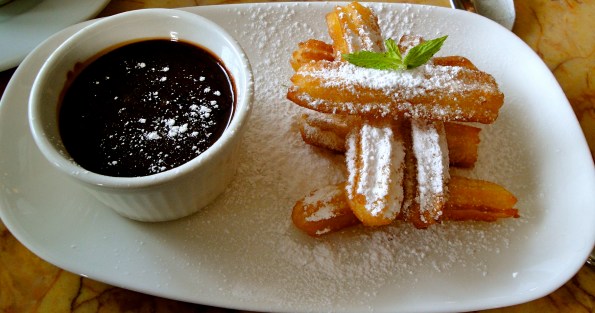
Churros from La Bodega de la Trattoria
Ok I know, I know, this is my second post and I am writing about another type of doughnut. I want to clarify two things: I don’t actually eat that much fried food (believe it or not), and Peruvians eat other things besides doughnuts. I just had to start the New Year off talking about something sweet (though this may in fact be breaking my New Year’s resolution).
The history of how Churros came to be is debated. One tale claims Spanish shepherds invented the Churro, while another story says that Portuguese sailors brought the Churro to Europe (the Portuguese supposedly encountered some dessert similar to the Churro in China and modified it to what we now know as the Churro).
Though uncertain of the Churro’s origins, we are sure that this dessert is not a Peruvian creation. Nevertheless, you can find delicious Churros throughout Lima. I particularly enjoy the ones from La Bodega de la Trattoria, which come with hot melted dark chocolate. At this restaurant, you also get a nice view of the Huaca Pucllana. When you are in Peru, you should definitely eat a Churro but perhaps not the same day as you indulge in Picarones.

I have spent about 3 percent of my life in Lima, so I am well acquainted with Peruvian food. One of my favorite Peruvian desserts is Picarones, doughnuts made primarily of sweet potato and pumpkin that originate from the 17th century. Apparently, Picarones were created to replace a more expensive dessert (called Buñuelos).
What resulted were heavenly pieces of fried dough shaped into rings, fried until crispy but still soft in the center. Picarones are drenched in a delicious and sweet syrup made from chancaca (which is just solidified molasses).
Now you might ask: “Where do I get these heavenly treats?” If you are in Lima, you can find Picarones in most Peruvian-style restaurants (which serve food Peruvians call “comida criolla”). I recommend the Picarones from the restaurant La Mar (which also has the best ceviche).
If you cannot make it to Peru, there are two La Mar restaurants in the U.S. — one in New York City and another in San Francisco. I have not been to either restaurant but if the Picarones are half as good as the ones I ate in Peru, they are well-worth a trip to either location!
 Food Follower